
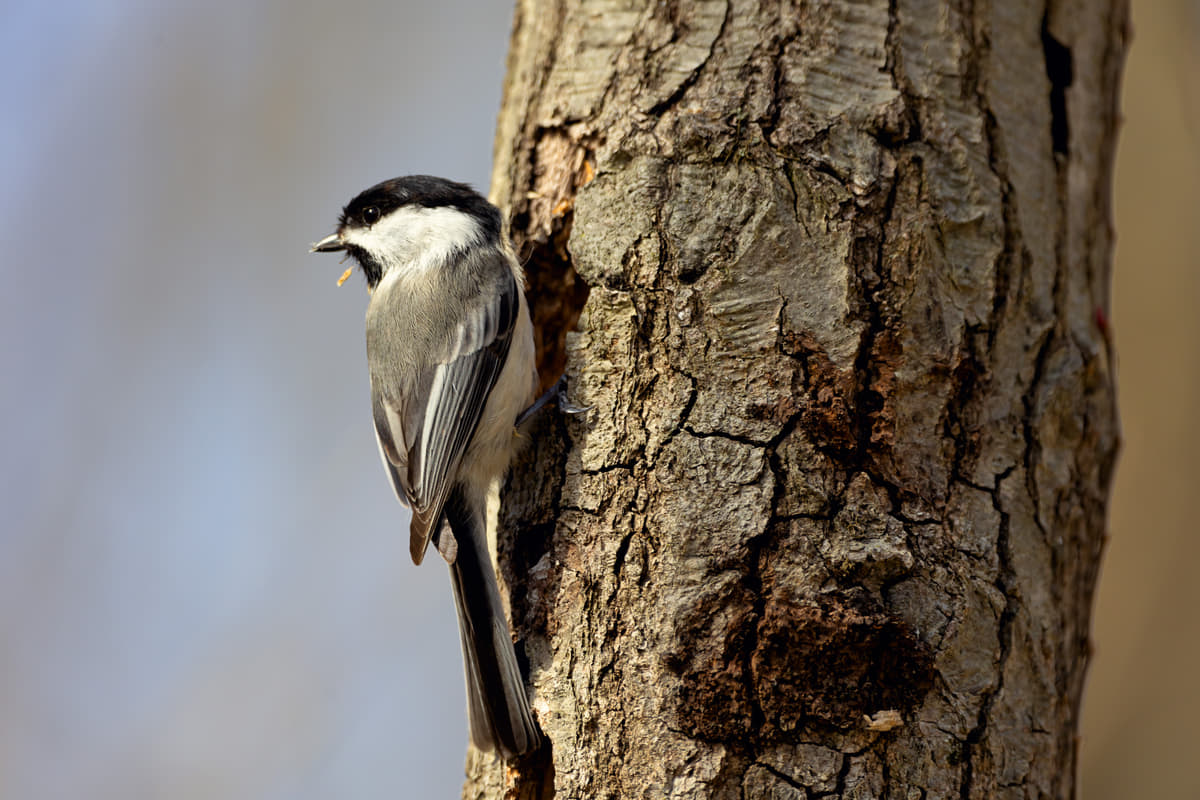
Chickadees are adorable little birds that have a lot to teach us! They are musical, they are persistent, they sound the alarm when things aren't right. In this episode, I talk with Margaret Noodin, author of What the Chickadee Knows, about listening and how chickadees teach us to listen. Together we talk about how Chickadees aren’t afraid to encounter something larger than themselves. These tiny birds can hold together their flocks with their vocalizations, remember where 100s of items of food are cached throughout the winter, and they keep us company through the winter when many other birds migrate. The soundscapes of chickadees can teach us something about how to live in our own soundscapes. Margaret calls them “social justice birds”… and in these times, we need a model for social justice. Chickadees teach us to show up – to be there when something is amiss! To sound the alarm. We should listen to the chickadees.
Thank you to Margaret Noodin for spending time with me and recording her poem, Chickadee.
Thanks to Ben and Sam Luhmann for sharing their protest videos so I could capture the sound of ICE Protests.
These are the sources I read as I wrote this episode:
Dixon KL, Stefanski RA. 1970. An appraisal of the song of the black-capped chickadee. The Wilson Bulletin, 82:53-62.
Dolby AS, Grubb TC, Jr. 1999. Functional roles in mixed-species foraging flocks: a field manipulation. The Auk, 116:557-559.
Frazier EK, Selman ZA, Price CA, Papes M, Freeberg TM. 2025. Mixed-species floc diversity and habitat density are associated with antipredator behavior in songbirds. Diversity, 17:363.
Freas CA, Roth TC, II, LaDage LD, Pravosudov VV. 2013. Hippocampal neuron soma size is associated with population differences in winter climate severity in food-caching chickadees. Functional Ecology, 27:1341-1349.
Freeberg TM, Coppinger BA, Eppert SK. 2023. Mixed-species flock composition matters: interspecific influences on finding novel food in North American parids. Philosophical Transactions B.378:20220113.
Hampton RR, Sherry DF, Shettleworth SJ, Khurgel M, Ivy G. 1995. Hippocampal volume and food-storing behavior are related in parids.
Mammides C, Chen J, Goodale UM, Kotagama SW, Sidhu S, Goodale E. 2015. Does mixed-species flocking influence how birds respond to a gradient of land-use intensity? Proceedings Royal Society B, 282:20151118.
Odum EP. 1941. Annual cycle of the black-capped chickadee: 1. The Auk, 58:314-333.
Pizarro JC, Larson MH. 2017. Feathered roots and migratory routes. Nature and Culture, 12:189-218.
Weisman R, Ratcliff L. 2004. Relative pitch and the song of black-capped chickadees. American Scientist, November-December:532. https://www.americanscientist.org/article/relative-pitch-and-the-song-of-black-capped-chickadees accessed 25 March 2026.
Welklin JF, Sonnenberg BR, Branch CL, Heinen VK, Pitera AM, Benedict LM, Whitenack LE, Bridge ES, Pravosudov VV. 2024. Spatial cognitive ability is associated with longevity in food-caching chickadees. Science 385:1111-1115.