
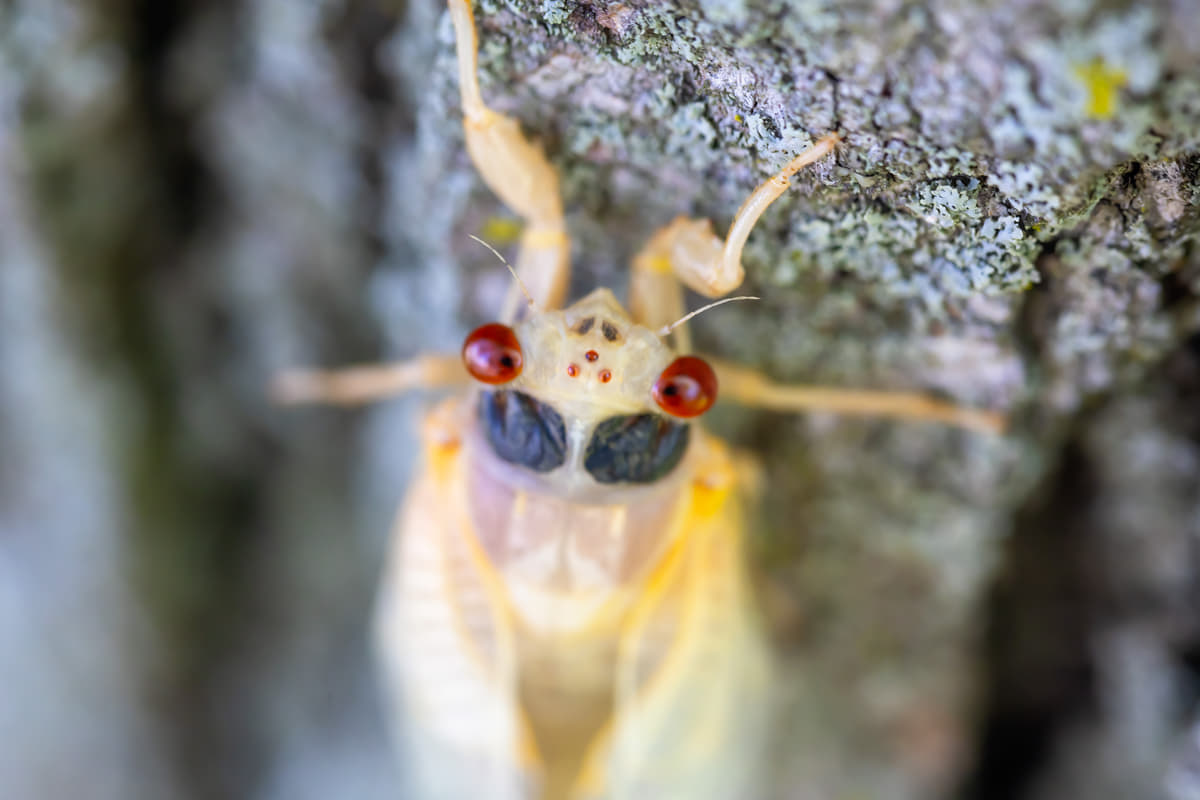
I have been anticipating the emergence of the 17-year Brood XIII cicadas for a long time! As soon as I started recording soundscapes, I was trying to learn about all of the ways I could record cicadas! Of course, I used all of my unidirectional microphones and my programmable microphones to record the soundscapes, but I also used my hydrophone to record the nymphs below ground, and I also used my contact microphones to record the cicadas as they emerged from the soil and moved up the tree.
Periodic cicadas in the genus Magicicada are the longest-lived insects that have either 13 or 17-year below-ground nymph stages. This year (2024) there was an emergence of a 17-year brood (Northern Illinois Brood) and a 13-year brood (Great Southern Brood) at the same time! It's the first time since 1803, and it's resulted in a lot of excitement!
I really enjoyed learning about cicadas as I wrote this episode! Some of the questions I answer:
- How do cicadas know when to come above ground?
- How do the cicadas know where to create chorus centers?
- What/who eats cicadas?
I hope you enjoy listening to the soundscapes of this amazing experience!
Here are some sources I used to write this episode:
Cooley JR, Marshall DC, Hill KBR. 2018. A specialized fungal parasite (Massospora cicadina) hikacks the sexual signs of periodical cicadas (Hemiptera: Cicadidae: Magicicada). Nature Scientific Reports 8:1432.
Duke L, Steinkraus DC, English JE, Smith KG. 2002. Infectivity of resting spores of Massospora cicadina (Entomophthorales: Entomophthoracea). Journal of Invertebrate Pathology, 80:1-6.
Getman-Pickering ZL, Soltis GJ, Shamash S, Gruner DS, Weiss MR, Lill JT. 2023. Periodical cicadas disrupt trophic dynamics through community-level shifts in avian foraging. Science 382:320-324.
Karban R, Black CA, Weinbaum SA. 2000. How 17-year cicadas keep track of time. Ecology Letters 3:253-256
Nahirney PC, Forbes JG, Morris HD, Chock SC, Wang K. 2017. What the buzz was all about: superfast song muscles rattle the tymbals of male periodical cicadas. FASEB Journal20:2017-2026.
Sheppard LW, Mechtley B, Walter JA, Reuman DC. 2020. Self-organizing cicada choruses respond to the local sound and light environment. Ecology and Evolution 10:4471-4482.
Yang LH. 2006. Periodical cicadas use light for oviposition site selection. Proceedings of the Royal Society Bulletin 273:2993-3000.
Websites: